Innovation and growth with UiPath RPA and Document Understanding
In early 2020, HCS (a subsidiary of NN) launched an ambitious RPA project with the help of Tacstone. HCS offers advice and implementation services in areas such as social security, absenteeism and sustainable employability. The world in which HCS operates is very complex and subject to changing legislation. In this complex world, HCS has the ambition to grow significantly in the coming years and to be at the forefront of innovation. The management of HCS sees RPA as a technology that can play an important role in realizing this ambition.
“Our ambition is to be the market leader in our field. We know social security legislation extremely well and link our expertise to a strong technological foundation. To increase our added value for clients, we need both substantive knowledge and an innovative and scalable model. But much of our work is labor-intensive, complex, repetitive, and therefore sometimes error-prone. In 2019, we saw in the emergence of RPA an opportunity to further automate precisely that part of our work. I was convinced that this would not only allow us to become more efficient, but also leave more time for the truly valuable advisory role with our clients.”
James van der Spek | Director of IT and Innovation
Don’t start with low-hanging fruit
Many RPA projects begin by automating a few relatively simple tasks. These tasks are usually not mission-critical and the expected benefits are limited. The goal is to show – by picking the proverbial “low-hanging fruit” – that RPA works. This creates support for expanding the project thereafter. At HCS, we did things differently.
Director James van der Spek and Project Leader Yoeri Weekhout were convinced of the possibilities of the UiPath RPA platform even before the start of the project. They had done their homework well and seen what was possible in practice. They asked Tacstone whether it was possible to automate a complex and business-critical process with RPA, namely the processing of large quantities of documents. In this process, large numbers of letters are received weekly, read, checked and processed in an ERP solution. A time-consuming and error-prone process that was also perceived as very tedious by employees.
Trial and error
The development of the robot script became a process with the necessary trial and error. In particular, reading out, recognizing and processing the documents and tables from the letters via ABBYY OCR (Optical Character Recognition) required more iterations than anticipated and thus the necessary perseverance of all involved.
“The first phase of our project showed how important it is to create space within which you can learn together and also make mistakes. Without that space it would never have been possible to achieve this innovation. We are proud of the final result of the first development project: Jarvis, our first digital colleague, was born. Jarvis turns out to be able to almost autonomously and automatically process a specific document from the Tax Office. Our colleagues are enthusiastic about Jarvis. It easily saves them 15 minutes of manual data entry per inflow list.”
Youri Weekhout | Project Manager

Getting started with UiPath Document Understanding
Even before the inflow list process had gone into production, the project team had already selected a second process. The potential impact of RPA in this second process could be expected to be even greater. The case management department receives and processes large numbers of “Decisions” every week. These are letters that come from the UWV. For years, reading, checking and processing the data from these letters has been a manual, time-consuming and also error-prone activity within HCS.
Good news for the project team was that a new release of UiPath Document Understanding had been released. It quickly became clear that this solution was very suitable for automating the complex document processing at HCS.
What is UiPath Document Understanding?
UiPath Document Understanding (DU) combines RPA and AI to extract and interpret data from various documents and enable end-to-end document processing. DU works with structured and unstructured documents, recognizes objects such as tables, handwriting, signatures or checkboxes, and can handle a wide variety of file formats. DU provides a framework with so-called drag and drop activities that allow us to build end-to-end workflows in UiPath Studio.
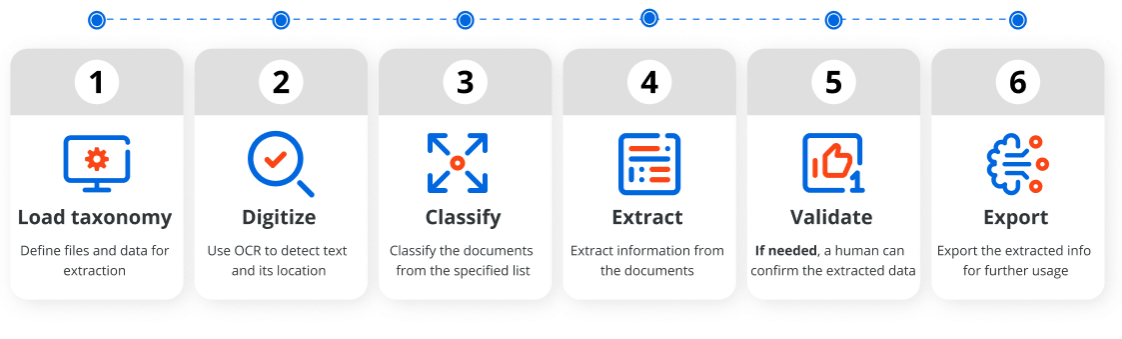
Processing decisions with UiPath Document Understanding
With UiPath Document Understanding, it proved possible to greatly automate the processing of decisions. Case managers now upload the decisions into the absence system. The software robot logs into the absence application, downloads the letter files and offers them to the “Document Understanding Pipeline. The files automatically go step-by-step through this ‘laundry line’ and are digitized and classified. The relevant data is then extracted from the letters.
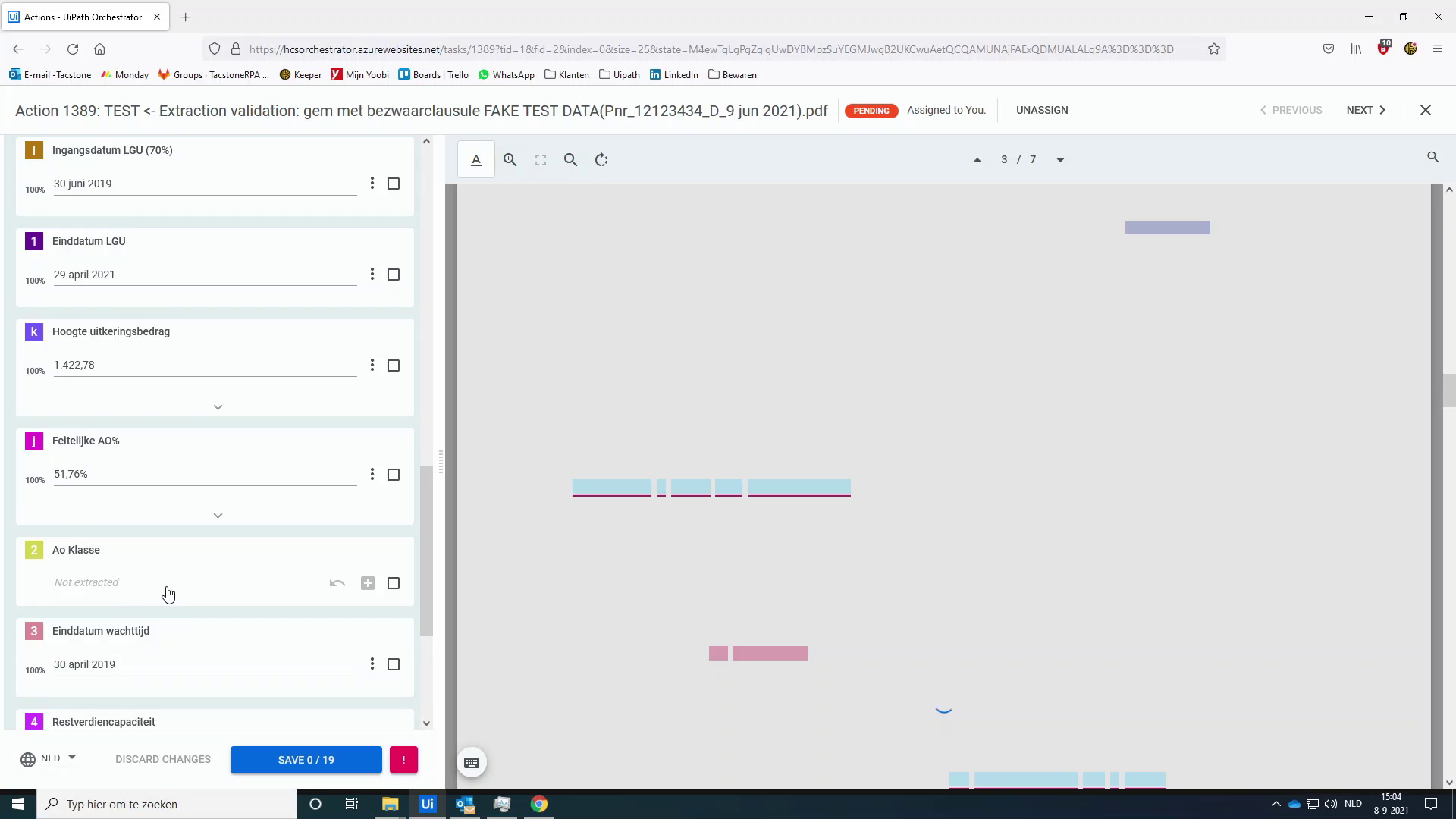
Document Understanding works with a learning model. As a result, the robot becomes ever so slightly smarter. To do this, the robot needs the help of the HCS employees. Every time the robot does not recognize a new letter variant or data in a letter with sufficient certainty, it calls for help from an employee. The employee is then notified to review or complete information. Then the robot handles the process further.
“With UiPath Document Understanding, we have been able to build a robust process that can recognize, classify and validate a wide variety of dispositions. The great thing is that the Machine learning model we use in this process is continuously trained, so that the model is getting smarter and smarter and more and more documents can be processed automatically. Currently, our robot can process about 50 percent of all documents automatically, but I expect it to exceed 80 percent in the foreseeable future. That will save up to 90 hours of time per month. Time that can be used to generate customer value instead of being busy doing administration in the absence system.”
Youri Weekhout | Project Manager
“Does take some getting used to that new digital colleague”
For the HCS employees involved in the daily processing of orders, the new digital colleague takes some getting used to. The flawless processing of hundreds of decisions per month is no sinecure with all the complex regulations and procedures involved. It requires a lot of ready knowledge about the numerous steps, decision rules and many exceptions in the process. It is logical that there is at least some hesitation at the idea of deploying a software robot, which then comes to help as a kind of new virtual colleague to perform the work not only faster but also error-free.
Nonetheless, we have now succeeded in bringing in as much relevant knowledge as possible about the process and instructing the software robot in such a way that it can already recognize, read and process more than half of the decisions independently. A great first step, which at the same time makes us curious about what else is possible.