


RPA at healthcare institution Pluryn: far-reaching automation of invoice processing
Pluryn is a large healthcare institution with over 7 thousand professionals and 1000 volunteers. They support and treat young people and adults with disability, youth and mental health services. In 2020, Pluryn started RPA. The initial goal was to reduce administrative workload. The results were positive and several processes have now been successfully automated. The ambition reaches further. Therefore, at the request of Pluryn, Tacstone has trained an employee of the care institution to become a full-fledged RPA Developer. This way, Pluryn and Tacstone can automate even more processes together in co-creation and further reduce the workload.
Automate invoice processing (even further) with UiPath RPA
Pluryn has automated the process of invoice processing in recent years. Most invoices are no longer received on paper, but as pdf attachments by e-mail. Although such a pdf invoice is digital, it cannot simply be read by the computer. Pluryn uses ProActive software for this purpose. This software reads the pdf invoices and translates the content into text. The manual retyping of all data from the purchase invoices is therefore no longer necessary. This saves a lot of time and occasional typing errors. But because this software cannot process the pdf invoices fully automatically, Pluryn employees still often had to perform the same actions. So an ideal opportunity to deploy the software robot.
The virtual employee Accounts Payable
The goal of the first RPA project was clear: automate the invoice processing as much as possible, using the existing software. The consultants of Tacstone and the employees of Pluryn mapped out the process together. For each process step it was examined whether the software robot could take over (part of) the manual work of the employee. The costs for development and management of the robot script were compared with the expected benefits, such as direct time savings.
“Our goal was emphatically not to automate every incidental invoice and every possible exception. That is not feasible from a cost/benefit perspective. Our intention was to transfer the most labor-intensive tasks to the software robot. The exceptions and the less frequent invoices are then simply still handled by our employees.”
Thomas Geelkerken | Team Leader Business Analytics
The invoice processing process was first logically broken down into three sub-processes. A framework was built for this purpose. Within this framework, the project team started to automate the complete invoice processing for the top 10 suppliers (read: the 10 suppliers who annually submit the most invoices to Pluryn).
A framework for automated invoice processing
The end-to-end process of invoice processing consists of a series of sequential actions. It starts with the e-mail inbox in which the invoices are received and ends with the payment of the approved invoices. To properly automate this process, Tacstone Technology has developed a framework. This framework consists of three sets of robotic scripts, which can automate the successive steps in the process.
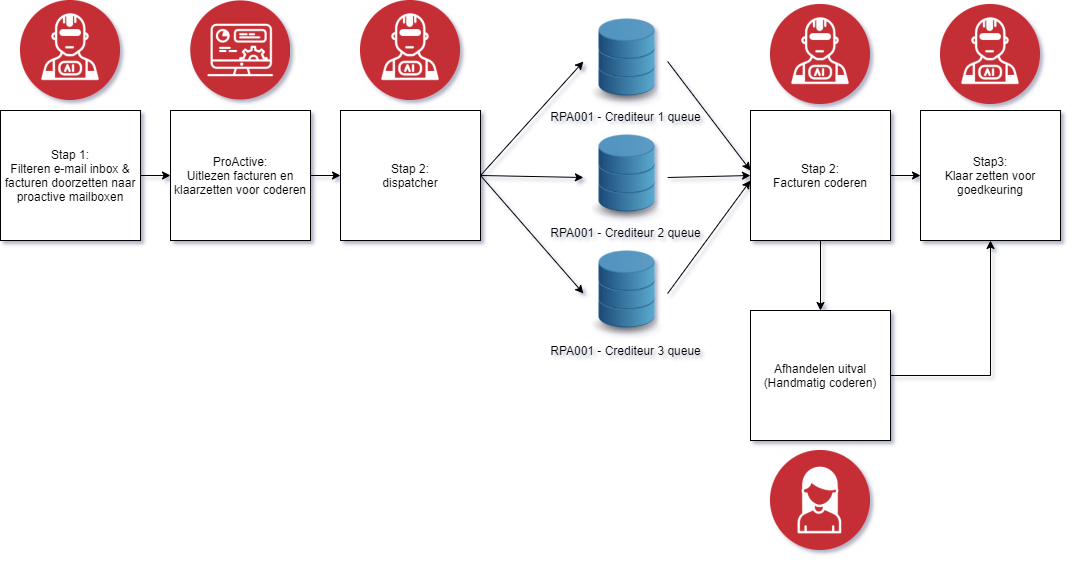
Explanation of the framework
Step 1: reading email inbox and forwarding invoices to ProActive mailbox
Every evening, the software robot reads the e-mail inbox in which purchase invoices are received. For each email with attachment, the robot checks whether it is actually an invoice and whether it meets a number of specific requirements. E-mails that do not meet these requirements are filtered out. The emails that do comply are forwarded by the robot per creditor to the relevant ProActive mailbox.
Step 2. Coding invoices in ProActive.
The software robot logs into ProActive and starts coding each purchase invoice one by one. The robot opens an invoice and fills in the missing data based on characteristics and decision rules that are often specific per creditor. The robot fills in fields such as “description,” “period” (in which month the invoice should be posted), “cost center” and “general ledger account.” After the robot completes all the data, it handles the ticket in ProActive and changes the status to “coded.”
Step 3. Forward invoices to the approval process.
The software robot logs into ProActive and goes to the invoice overview. Here the robot selects all fully coded invoices. These are both the automatically (by the robot) coded invoices and the manually (by the employee) coded invoices from that day. All invoices are forwarded to the approval process with the push of a button. The robot waits until all invoices are passed and then closes ProActive.
Optimally scalable: add a new creditor within 1 day
The framework, developed in UiPath Developer Studio, works with so-called ‘library items’ for standard rules and controls. The framework also includes a ‘dispatcher performer setup’ that allows the Pluryn employee to more easily detect any errors in the handling of an invoice and resubmit a ticket as needed.
“The framework ensures that the process remains clear and manageable from start to finish. Moreover, the framework makes it possible to reuse existing logic. This allows us to add a new supplier within a day. So that means that all invoices from such a new supplier can be processed by our virtual employee Accounts Payable right from the next business day.”
Jasper van Schaik | Process and data technology developer
Monthly 400 invoices processed automatically and error-free
So Pluryn’s new virtual employee now reads out the accounts payable mailbox every evening. The next morning, any fallout, which is usually less than ten percent of the invoices processed, is prepared for the department’s employees. About 400 invoices per month are now processed by the software robot. This results in a time savings of about 40 hours per month. This time can now be spent on other things such as further professionalizing the accounts payable process at the organizational level, better supporting more complex supplier issues. The result also means that budget managers can get a correct and complete insight into the costs. A quality improvement in our management information.
The software robot still has time to spare: follow-up approach in co-creation
The invoice processing process is automated with a so-called unattended robot from UiPath. This robot can start the process without the intervention of an employee, log into the applications, perform all tasks and neatly close the process again. The robot is available 7 days a week and 24 hours a day and can therefore perform many more tasks. For example, the same robot now also handles online applications for VOG certificates.
Pluryn employees and management are enthusiastic about the first applications of RPA. The enthusiasm to automate more administrative processes has grown. Pluryn has therefore asked Tacstone to train one of its employees to become a full-fledged RPA Developer. In this way, Pluryn is thus making a start on building up knowledge of RPA in-house. In the coming period, the parties will continue to work together in a co-creation model, in which Tacstone provides support as a knowledge partner and delivers additional development capacity where necessary.


