


More hands at the bedside through smart automation in the primary process at Nursing Home
Quality improvements by ‘Harry’

Time savings for staff
Saved 50 to 80 hours per month
Robotic Process Automation(RPA), AI and Low-Code, meanwhile, are common ways to innovate in support processes. But in the primary process, these technologies are even less widely represented. Vierstroom Verpleeg Thuis is a pioneer in this area with the recent commissioning, in partnership with Tacstone, of a custom low-code application specifically for rostering.
Vierstroom Nursing Home, part of Fundis, is an organization with a special offering: nursing home care in people’s homes. The Gouda-based organization provides care and support to clients living at home who need more wellness and meal support in addition to care, including clients with dementia. These include care and nursing services, alarms, day activities, food and drink and domestic help.
In line with this innovative nature of Nursing Home, the smart use of technology is also part of the strategy. Director Marieke Oldewarris: “Within healthcare organizations, the previously mentioned technologies are mainly used in back-office processes such as billing and registration. We chose to support our employees by deploying Low-Code on the front end, so really in the primary process.”
Smart organizing
That desire to innovate comes from the nature of the business. Oldewarris explains: “When we started eight years ago, it was financially loss-making because it was organized like in the nursing home. But there you have thirty residents at one location, it’s very different to visit them at thirty different addresses. So process management and technology soon came into the picture to be able to offer care financially feasible.”
She gives an example of how technology supports, “We used to drive around with a numbered set of keys in the car. Nowadays we use an app to open doors. The same goes for care records; there used to be folders in clients’ homes, now that’s digitized. But the biggest problem in healthcare is staff shortages. We do work with technologies like tablets and tools to support day activities, but in the end that doesn’t provide enough.”
Hands on the bedside
So Nursing Home wanted technology that actually frees up people for “extra hands at the bedside. “I talked about this about a year ago with someone from the back office, who was working on automation. That’s how we came up with the idea of exploring how we could apply this to the primary process as well, in this case the very time-consuming processes of rostering and planning. Scheduling determines who works when, planning then determines where you go when you work. These are two different processes. In healthcare, rostering takes a lot of time, and planning takes even more time.”
Because WelThuis, part of Fundis, was already working satisfactorily with Tacstone Technology, Oldewarris also began discussions with them. “I asked Tacstone to start with rostering, with the ambition to eventually robotize the scheduling process as well.”

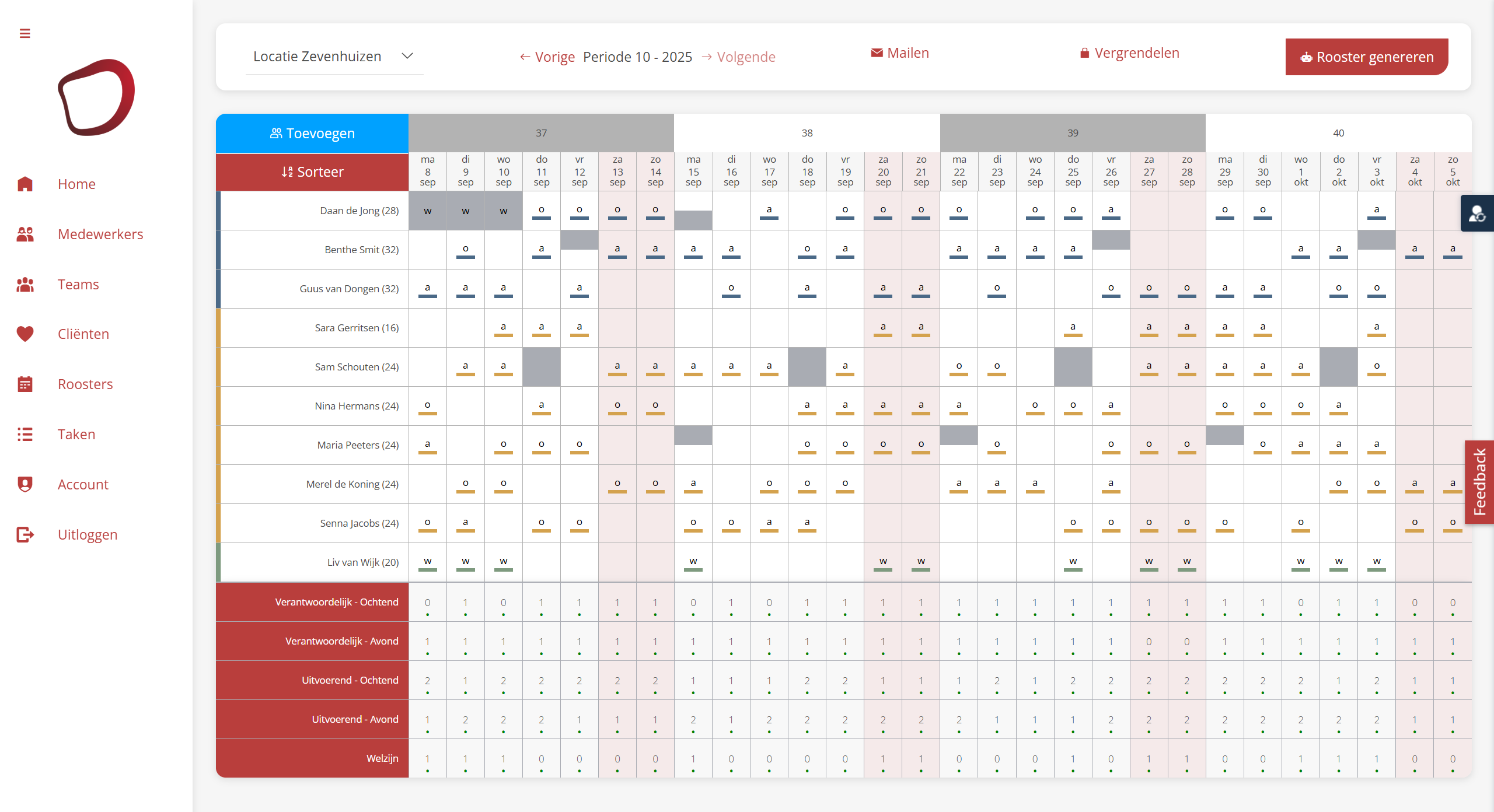
“We are in the first stage now, and last week ‘Harry’ created the first roster for our employees.”
Mariek Oldewarris | Director of Nursing Home
Criteria
Automating scheduling is crucial, she says, to get more hours available for executive care. The process was already set up efficiently, which made it suitable for Low-Code and RPA “We work based on fixed criteria with few exceptions. Everyone works all shifts with us. We have a health and safety responsible roster, which means no one has a broken shift and no one has a morning after an evening shift. Someone who works 24 hours a week should get 16 shifts. These are hard criteria on which the roster is based.”
“So that’s exactly what the algorithm is good at, because it can’t deal with gray areas or vague wishes. That’s often the problem when creating rosters manually, but we had already overcome that in the process. Of course along the way we discovered that sometimes there are exceptions, but we were able to accommodate those.”
Freeing up hours
The first roster created by “Harry” is 80 percent correct, according to her. “We are working on improving it now. Harry is still in his familiarisation period, so there may still be mistakes. But I’m convinced that this will eventually save a lot of time. Smart scheduling will save us between 50 and 80 hours a month, which we can use for care. And scheduling will save a lot more. Nurses spend four hours a day per team on planning. With eight teams, that’s 32 hours a day, which amounts to 160 hours a week. I expect that robotic planning could start to give us two to four FTE per week.”
An additional benefit is quality improvement. “Despite a fixed system, it was human work. Then mistakes do creep in, such as someone accidentally being scheduled for a morning shift after an evening shift. Harry doesn’t make those mistakes. So what we also achieve with this is more stability in the rosters.”
Quick impact
She looks back with satisfaction on the cooperation with Tacstone: “The development of the robot went quickly. I think that’s because we work with two decisive organizations. We switch quickly, and so does Tacstone. If we came across something Harry didn’t do right, it was quickly adjusted. We have the same vision and are on the same page, which helps tremendously in the process.” The organization is pleased with the robot:
“Most nurses experience scheduling as a burden. They would much rather get to the clients.”
Marieke Oldewarris | Director of Nursing Home
Colleagues at other Fundis companies are also watching this development with interest. They too would like to save time, but they are sometimes still wait-and-see. That doesn’t matter, we like to do that pioneering work, it’s in our DNA.”


