Smart planning and scheduling delivers Vierstroom Nursing Home more time for care
Workforce planning is the foundation of good healthcare delivery. Yet many healthcare organizations find that this process is disproportionately time-consuming. The combination of collective bargaining rules, contract hours, changing care demand and personal preferences makes putting together a balanced schedule a complex and error-prone puzzle. In practice, this meant for planners that they often spent many hours on this process, which is time that could not be spent on direct care.
For Vierstroom Verpleeg Thuis, an organization that provides nursing home care at home, this was a recognizable problem. The existing rostering options within the ECD did not provide sufficient support for daily practice. Together with Tacstone Technology, a solution was therefore sought that not only worked faster, but also did justice to employees, rules and quality of care.

What applications?
Customized scheduling and roster application (Mendix low-code), linked to ECD (ONS Nedap)
Total time saved:
Average 50 to 80 hours per month less scheduling time
Result of the solution:
Faster insight, fewer errors and more time for healthcare professionals
Reason
Within Vierstroom Verpleeg Thuis, scheduling and rostering were largely performed manually. Although the Electronic Client Dossier (ECD) provided insight into staff availability and hours worked, the responsibility for actually creating the schedules rested entirely with the planners. When planning, they had to take into account a variety of factors such as contracted hours, qualifications, rest periods, and individual preferences.
This resulted in a significant time investment. On average, planners spent around four hours per day per team on scheduling. With multiple teams, this quickly added up to dozens of hours per week. In addition, the process was prone to errors: small changes or staff absences due to illness often led to new rounds of manual rescheduling. The organization therefore started looking for a way to automate this process without losing the human touch.
Approach
Tacstone Technology developed a custom solution for Vierstroom Nursing Home that largely automates scheduling and rostering. The core of this approach lies in combining data integration, smart scheduling logic and a user-friendly interface.
First, a link was realized with the existing ECD, so that data such as availability, contract hours and qualifications are automatically read in. Based on this data, a scheduling algorithm generates rosters that comply with collective bargaining agreements, statutory rest periods and organization-specific rules. Whereas planners previously had to make manual considerations, the system now does so consistently and reproducibly.
In addition, the solution was developed as a Mendix low-code application. This allows the functionality to be easily adapted to changing processes or requirements from the organization, without long development processes.
How does it work?
In daily practice, the process starts with the automatic retrieval of current data from the ECD. This information forms the basis for the algorithm, which combines all relevant rules and preferences into a proposal for the schedule. Within minutes, this creates a complete and balanced schedule.
Planners always retain control here. They can check the proposed schedule, adjust it if necessary and then publish it. The application gives employees insight into their shifts and they can indicate preferences or swap shifts, without this leading to an additional administrative burden for planners.
This way of working eliminates repetitive manual work, while increasing flexibility and transparency.
The application
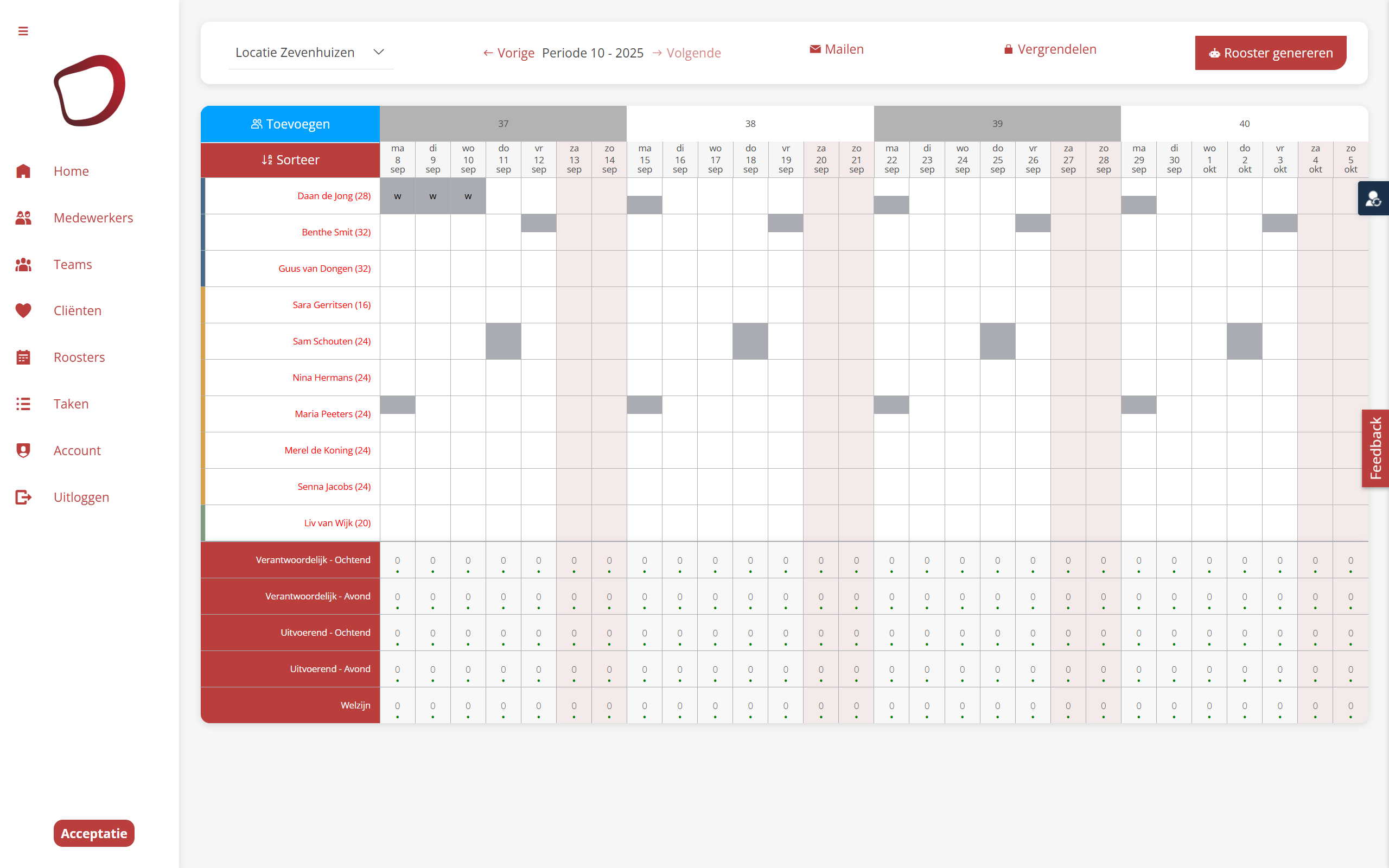
Results of the solution
The impact of the solution is clearly noticeable within Vierstroom Verpleeg Thuis. Where planners previously spent many hours on scheduling, the automation now delivers a saving of approximately 50 to 80 hours per month. This time becomes immediately available for supporting care teams or other tasks.
In addition, the quality of the rosters has improved. Because the algorithm applies rules consistently, errors such as invalid shift combinations hardly ever occur anymore. Employees experience more peace and predictability because schedules are available more quickly and better match their preferences.
In the longer term, the organization also sees potential to further automate the planning process, potentially leading to a structural reduction of several FTEs of planning work.
Comparison with the original situation
Before the implementation of the smart scheduling solution, rostering was an intensive manual process that required many hours per team each month. Corrections and changes took additional time and caused uncertainty for both planners and employees.
After implementation, rosters are generated within minutes, error proneness is greatly reduced and the process is more scalable. The biggest difference, however, is in the time freed up: where administrative tasks previously dominated, room has now been created for focus on care and support of staff.
How can you apply this in your organization?
Wondering how much time your organization can save with smart planning and scheduling?
Contact Tacstone Technology for a free consultation or demo and discover how automation contributes to more peace of mind, overview and time for care.