Automation of the Insurance Quotation Process
Preparing an insurance quote requires information from various documents and systems. Policy documents, customer data, and coverage information must be verified and processed before a quote can be prepared. By combining AI, RPA, and low-code, a large portion of this administrative work can be automated. The key question was: How can you speed up the quote process while reducing the risk of errors?

What technologies?
AI, RPA, and Low-Code
Result of the solution:
A more efficient quoting process in which data is automatically collected and processed, allowing employees to focus on checks, exceptions, and customer advice.
Reason
When preparing insurance proposals, account managers must gather information from various sources. These include existing policy documents, customer statements, premium data, and information about insurance products and coverage.
This data is often scattered across documents, emails, and administrative systems. Employees must manually extract the information, verify it, and re-enter it into the quote or policy system.
This not only takes a lot of time but also increases the risk of data entry errors. Furthermore, the required data varies by insurance product, which can make preparing a quote even more complex.
Solution
To automate the quoting process, we first identify what information is needed, where it comes from, and what tasks employees perform.
Next, we combine AI, RPA, and low-code to support the various process steps.
AI identifies and structures relevant information from policy documents, customer statements, and other documents. RPA and API integrations ensure that data can be retrieved from existing systems and processed.
A central quotation application brings this information together, allowing employees to verify, supplement, and use the data when preparing a quote.
How does it work?
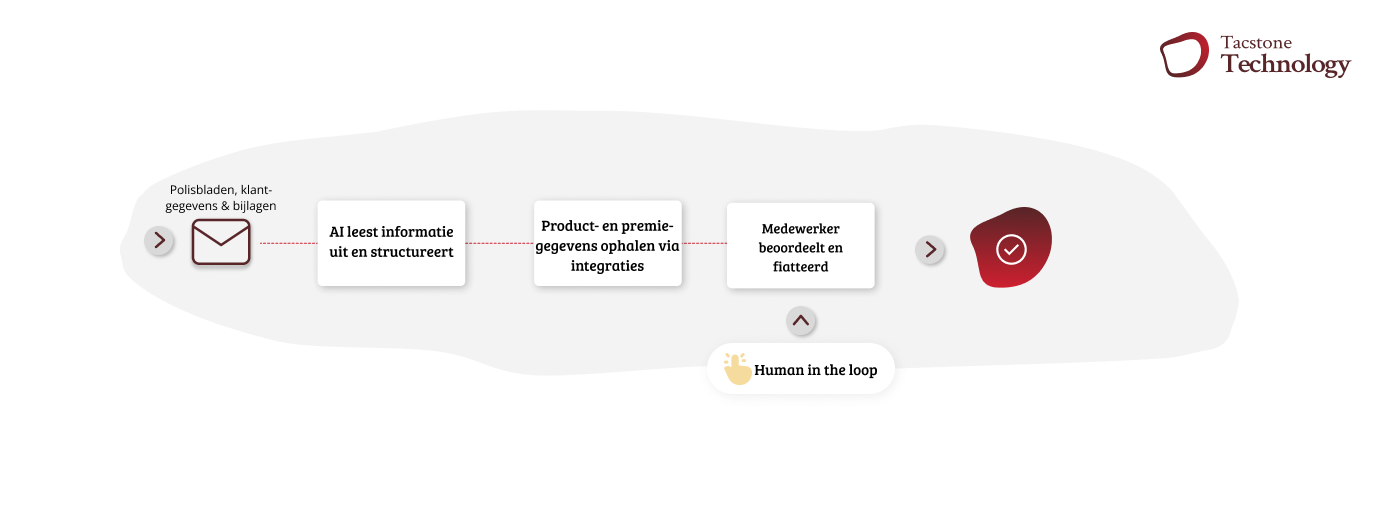
The automated quoting process consists of five steps, combining AI, integrations, and human review.
- Input – Collecting documents. The process begins with receiving relevant documents, such as policy schedules, customer data, and attachments. These form the basis for the quote proposal.
- AI Processing – Recognizing and structuring information. AI parses the submitted documents, recognizes relevant data, and converts it into structured information. This eliminates the need for employees to manually retype data.
- Integrations – Retrieving Product and Premium Data. Additional product and premium data is retrieved through integrations with existing applications, such as CCS Level, ANVA, and Keylane. This information is combined with the data from the documents.
- Review – An employee reviews and approves. The employee reviews the information that has been gathered, assesses any special circumstances, and approves the proposal. This ensures that human oversight is maintained.
- Output – Complete quote proposal. Once the review is complete, the quote proposal is ready. Automated processing speeds up the process, reduces the risk of errors, and gives employees more time to provide personalized customer advice.
This reduces the need for manual data entry, while employees retain control over substantive assessments and decisions.
The process
Result
By automating information processing within the quote generation process, employees spend less time manually entering data or transferring it between different systems.
This results in shorter turnaround times, a lower risk of data entry errors, and more efficient processing of insurance proposals.
In addition, this frees up more time for tasks where human expertise is essential, such as assessing exceptions, underwriting, and providing personalized customer advice.
How can you apply this in your organization?
AI, RPA, and low-code can also help your organization streamline the quote process. By automating repetitive administrative tasks, employees can prepare insurance proposals more quickly and with less manual data entry.