Technische Unie Explores End-to-End Test Automation with UiPath

Fewer IT incidents in production

Improved Business Continuity During Changes

Higher test quality and less pressure on key users
How do you ensure that business-critical processes continue to operate reliably as the IT landscape becomes increasingly complex and changes occur at an ever-faster pace?
For Technische Unie, this is a key issue. As the largest technical wholesaler in the Netherlands, the organization serves customers from more than 30 locations and multiple distribution centers with a product range of over two million unique items. Behind these services lies an extensive application landscape, in which SAP S/4HANA plays a key role.
In such an environment, a change in a single application can have consequences for an entire process chain. Technische Unie therefore wanted to investigate how test automation could help implement changes more quickly and reliably.
Together with Tacstone Technology, they explored whether UiPath Test Cloud could offer a suitable solution for this.
The Challenge: From Production Incidents to Innovation
Technische Unie was already using test automation solutions, including Selenium and Cypress. At the same time, a significant amount of manual work was still required, and requirements, test instructions, and results were scattered across Excel files, PowerPoint presentations, and emails, among other places.
The need, therefore, went beyond simply automating a number of individual test cases. Technische Unie was looking for a systematic and scalable way to perform end-to-end regression testing and thereby gain better control over changes in the application landscape.
The objectives were clear:
- Reduce the number of IT incidents in production.
- Better ensure business continuity during changes.
- Reduce the pressure on key users.
- Improve the quality of testing.
- Test more than just the standard “happy flows.”
This also changed the question. It was no longer just: How can we test more efficiently? But rather: How can we implement changes without introducing unnecessary risks to operations?
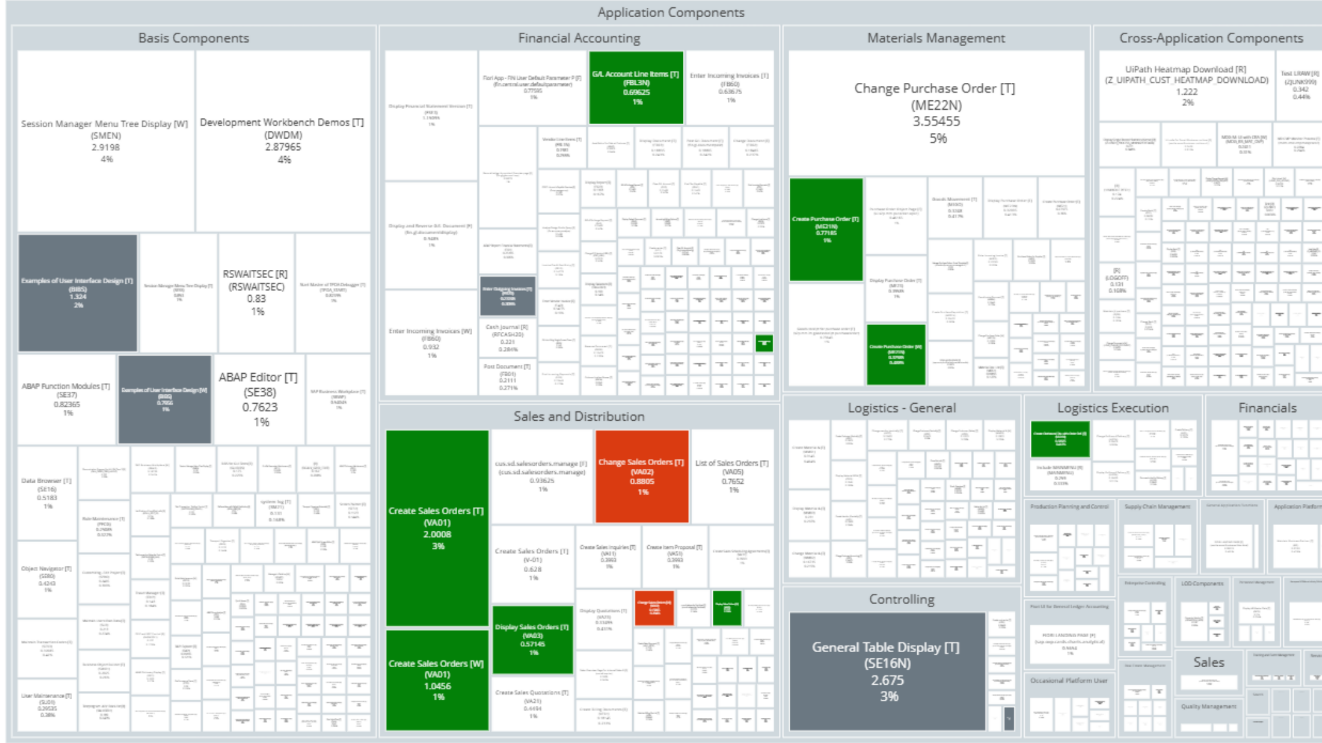
The SAP Heatmap shows which domains are most important to test.
Can we automate testing of the end-to-end Order-to-Cash process?
To thoroughly investigate this, we deliberately chose one of the most important and complex processes within Technische Unie: the Order-to-Cash process.
A sales order begins in the online store, but its processing doesn’t end there. The order moves through a chain of different applications and systems before a product is ultimately delivered to the customer and invoiced.
The end-to-end process consisted of twelve main steps: placing an order in the online store, checks in SAP, order approval via MAO, processing via MIF and various WMS systems, and finally in Descartes for routing and delivery processes. The final step was another check in SAP to verify the delivery status and invoice.
It is precisely that chain that makes testing complex. A single application may function correctly from a technical standpoint, yet something still goes wrong during the transfer between systems.
That is why the starting point was to test not just SAP or any other single system, but the entire business process from order to invoice.

“Automated testing of an end-to-end process in a complex application landscape with comprehensive test reporting is what sets UiPath apart.”
Ebert Knol | Partner, Tacstone Technology
In Search of a Single Scalable Approach
Technische Unie therefore set broad requirements for a potential solution.
The environment had to be capable of testing web, desktop, and mobile applications as well as APIs. Additionally, it was important that test automation could be developed and managed relatively easily in-house using low-code.
Centralized test management also played a key role. Requirements, manual tests, automated tests, and reports needed to be consolidated into a single environment as much as possible.
The evaluation also considered integration with Jira for defect management and requirements, SAP integration for Change Impact Analysis and other purposes, and the capabilities related to scalability and reusability. The use of AI for generating test designs and test automation was also taken into account.
Five weeks to test the capabilities in practice
During a five-week pilot, Technische Unie and Tacstone investigated whether UiPath Test Cloud could actually meet the specified requirements.
They did not opt for a simple demonstration environment. Instead, they used the complex Order-to-Cash process to determine whether an entire chain spanning multiple applications could be tested automatically.
The test cases and requirements were documented centrally. Subsequently, the entire Order-to-Cash process was built up step by step within the test environment, with the various components of the process—as separate test cases—being combined into a single end-to-end test flow.
In doing so, we also evaluated the speed at which tests could be developed and maintained compared to more programming-oriented solutions such as Selenium and Cypress.
“The greatest benefit of this project wasn’t automation. It was control over change. Test automation isn’t just about testing faster; it’s about making change predictable.”
Ebert Knol | Partner at Tacstone Technology
283 test automation scenarios identified
The pilot demonstrated that there is significant potential for further automation within Technische Unie’s testing landscape.
A total of 283 test scenarios were identified that can be automated using UiPath.
This has laid a solid foundation for further test automation. A possible next step is not only to automate more scenarios but also to train Technische Unie employees. This will help build expertise within the organization and ultimately enable test automation to be deployed more broadly and independently.
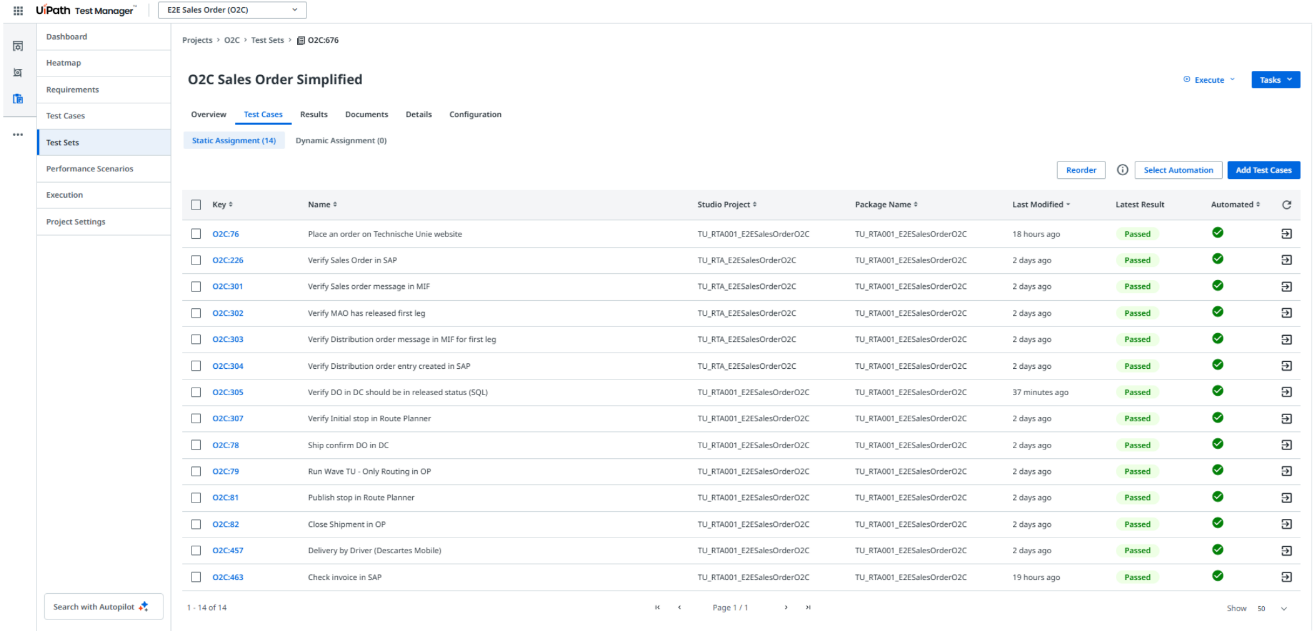
Overview of UiPath Test Manager and the automated test cases in the end-to-end Sales Order process.
The business case goes beyond the number of testing hours saved
Moreover, the potential value of test automation lies not only in the number of hours saved on manual testing.
A more significant value lies in preventing errors before they reach the production environment. After all, a production incident can have consequences for processes, employees, and customers.
In the project evaluation, a clear distinction was therefore made between efficiency and continuity. Reducing manual testing is valuable, but preventing production incidents can ultimately yield much greater benefits.
Test automation thus becomes not only a means of testing faster, but also of implementing changes more reliably.
What’s the next step? AI in the testing process
The possibilities of AI are also evolving rapidly within software testing. While traditional test automation primarily relies on predefined and predictable scenarios, there are increasingly more opportunities to leverage AI to support the entire test cycle.
Consider, for example, the evaluation of requirements, the automatic generation of test cases and test data, the development of UI and API test automation, the identification of outdated manual tests, and even AI agents that independently execute test cases without any development.
As a result, the field is gradually shifting from purely automated testing toward a collaboration between testers, automation, and AI. This shift toward Agentic Testing revolves around AI working with the tester, not in place of the tester.
Do you, like Partou also want to get acquainted with Communications Mining? And discover what benefits it offers your organization? Contact us for an introduction and/or demo.