Automation of the Current Account Process
Verifying insurers’ current account statements is often a time-consuming process. Each insurer submits data in a different way, causing employees to spend a great deal of time collecting, interpreting, and comparing information. By combining AI and RPA, these checks can be largely automated, and discrepancies can be identified more quickly. This raises the key question: How can you automatically verify current account statements and free up employees’ time to resolve discrepancies?

What technologies?
AI & RPA
Result of the solution:
A more efficient accounts receivable process in which transactions are automatically reconciled, allowing employees to focus on discrepancies and exceptions.
Reason
Intermediaries and authorized representatives periodically receive current account statements and transaction information from various insurers. This data must be verified and compared with their own policy and financial records.
The challenge is that every insurer provides information in a different way. Account statements vary in file format, structure, and data labeling. In addition, transactions are sometimes reported at the policy level and sometimes at the package level.
As a result, employees spend a great deal of time collecting, interpreting, and comparing data. Even entries that match correctly often have to be checked manually before it becomes clear which discrepancies actually require attention.
Solution
To streamline the accounts receivable process, AI and RPA are used to automatically process and compare data.
AI extracts data from current account statements and transaction records, regardless of differences in structure and formatting. The relevant data is identified and converted into a uniform, structured format.
The automation system then compares this information with the available data from the company’s own accounting system, such as ANVA. Among other things, opening and closing balances, rollovers, transactions, and other accounting data are checked.
Entries that match no longer need to be reviewed manually on a case-by-case basis. Discrepancies and entries for which no match is found are flagged separately for employees to review further.
How does it work?
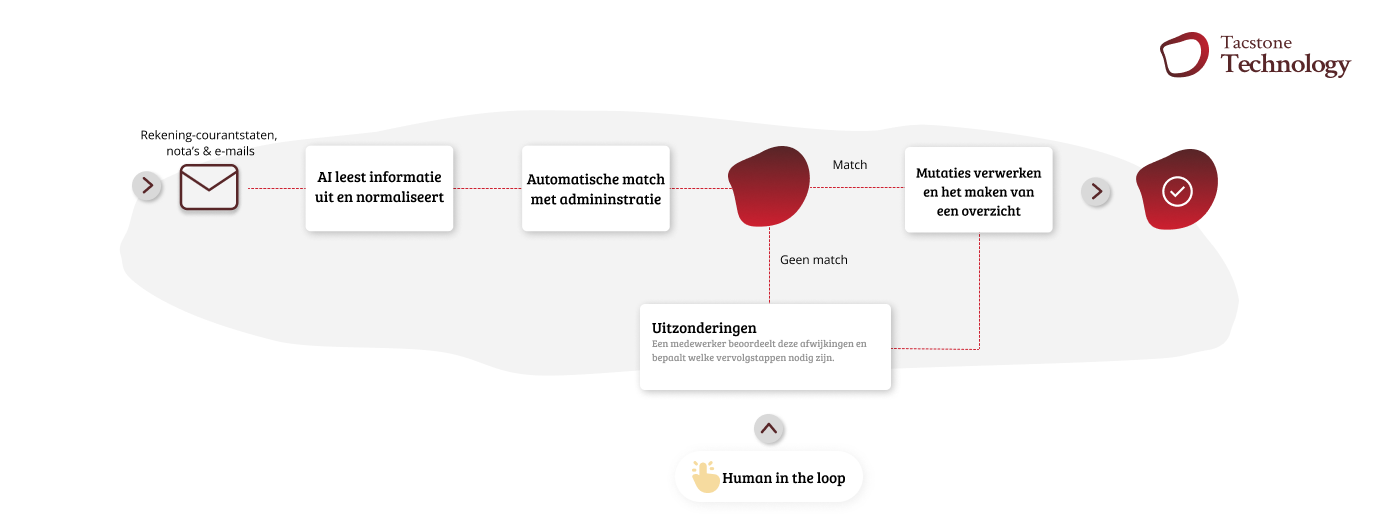
The automated accounts receivable process consists of five steps. AI and automation handle data processing and reconciliation, while employees maintain control over discrepancies.
- Input – Collecting current account statements. The process begins with receiving current account statements, transaction slips, and emails from various insurers. This information may vary in file format, structure, and layout.
- AI Processing – Extracting and Normalizing Information. AI extracts data from the submitted documents, identifies relevant accounting data, and converts it into a standardized format. This allows data from different sources to be processed in the same way.
- Comparison – Automatic matching with the accounting records. The processed data is automatically compared with the company’s own policy and financial records. This process verifies which entries match and identifies any discrepancies.
- Exceptions – An employee reviews discrepancies. Entries that do not match or for which no match is found are flagged separately. An employee reviews these discrepancies and determines what next steps are necessary.
- Output – Processed Changes and Summary. The process results in processed changes and a summary of the verified data and any discrepancies. This provides faster insight into discrepancies and reduces the need for employees to perform manual checks.
The process
Result
By automatically importing checking account statements and comparing them with the company’s own records, the amount of manual verification work is significantly reduced.
Employees spend less time searching for discrepancies between documents and systems. Instead, they gain immediate insight into the items that do not match and require further review.
This results in a more efficient reconciliation process, faster detection of discrepancies, and more time for tasks that require human expertise.
How can you apply this in your organization?
AI and RPA can also help your organization streamline its accounts receivable process. By automatically processing and comparing data, you can reduce the need for manual checks and enable employees to identify discrepancies more quickly.