
Deterministic AI: Why the Best Answer Isn’t Always the Most Likely One

Sem Bloem
Automation consultant
AI is increasingly being used to organize processes more intelligently. But not every form of AI is suitable for the same challenges. While generative AI generates answers based on probability, deterministic AI searches for solutions within predefined rules and conditions. This can make a big difference, especially when dealing with complex challenges, such as staffing planning in the healthcare sector.
What is deterministic AI?
Deterministic AI operates based on clear rules, frameworks, and constraints. Instead of predicting which answer is likely to be the best, the system calculates which solutions are possible within those conditions. In this context, “deterministic” means that, given the same input, the system will always produce a schedule that meets the same requirements and achieves the same performance. This approach is also known as mathematical optimization.
A distinction is made between two types of conditions:
- Hard constraints: rules that a solution must always satisfy, such as statutory rest periods or required qualifications.
- Soft constraints: preferences that are taken into account as much as possible, such as personal preferences or a fair distribution of shifts.
The system intelligently searches through all possible combinations. Anything that violates a hard constraint is immediately eliminated. From the remaining options, the system selects the schedule that best meets the soft constraints.
The Difference from Generative AI
Generative AI, such as ChatGPT, generates responses based on patterns and probabilities. This makes the technology suitable for tasks such as writing text, summarizing information, and answering questions.
Deterministic AI works differently. It calculates solutions that comply with explicit rules and constraints.
For example, a generative language model might propose a staff schedule that seems logical. However, this does not guarantee that all legal requirements, contractual agreements, and qualifications have been correctly taken into account.
Suppose a language model schedules a nurse for the early shift on Monday after three night shifts. On paper, the schedule looks fine, but the Working Hours Act requires at least 46 hours of rest after a series of three or more night shifts. Such an error is only noticed if someone happens to spot it.
A deterministic system checks these conditions precisely during the calculation. The result is therefore not simply the most likely answer, but a valid solution within the specified parameters.
Case Study: Staff Scheduling in Healthcare
The healthcare sector is under pressure. Staff shortages, increasing demand for care, and high workloads are making it increasingly difficult to schedule employees effectively.
When there aren’t enough staff members available, the focus shifts from forward planning to solving immediate problems. Open shifts must be filled, and unexpected absences must be covered.
This can lead to a vicious cycle:
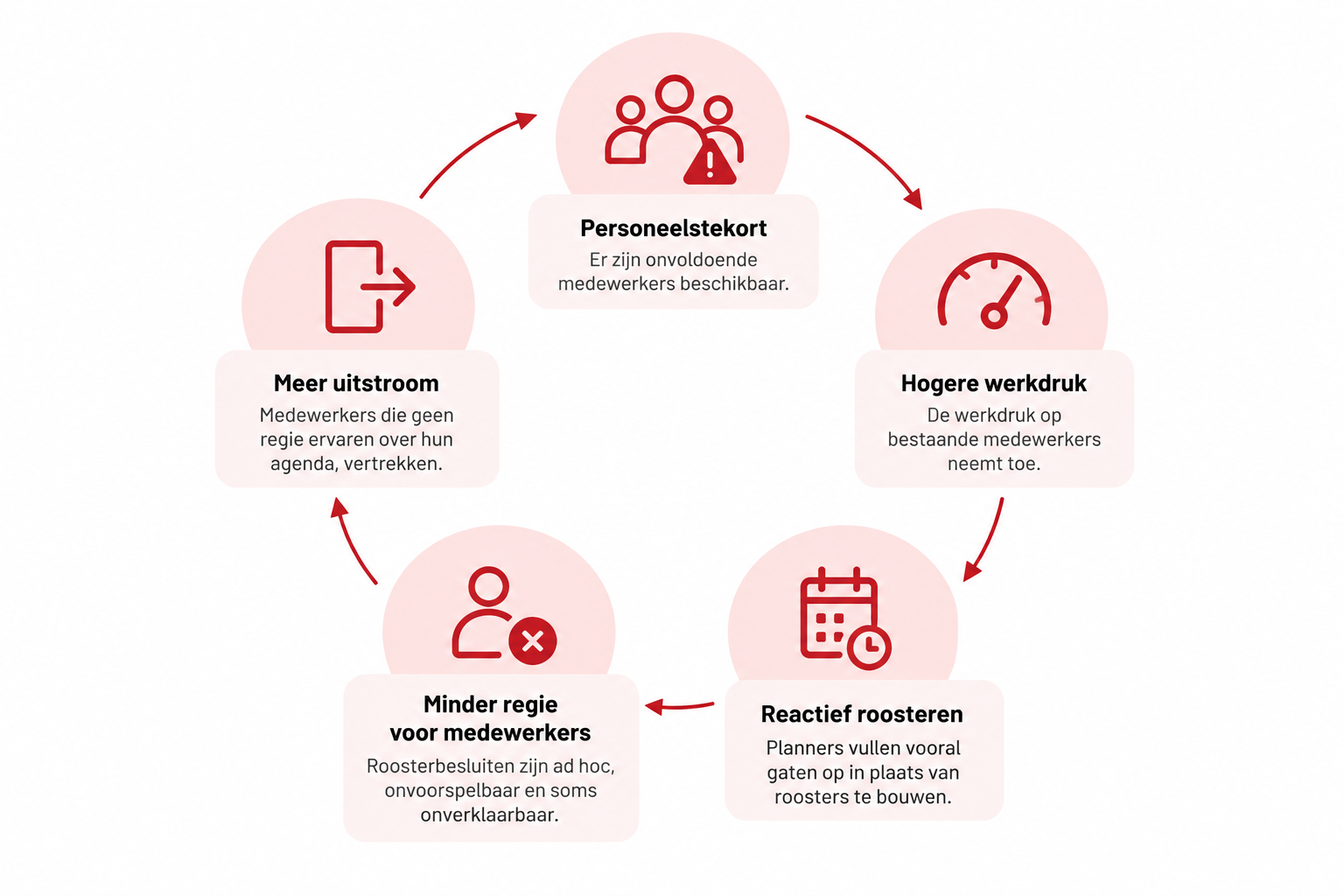
Employees who feel they have little control over their work hours or who regularly face unexpected changes lose the sense that they are in control of their own schedules.
So the challenge isn’t just about filling all the shifts. It’s about creating schedules that are also fair, predictable, and sustainable.
How deterministic AI helps with planning and scheduling
This is exactly where deterministic AI makes a difference.
A care schedule must take into account care demand, availability, contracted hours, qualifications (such as the right mix of nurses and nursing assistants per shift), laws and regulations (such as rest periods after a night shift), and personal preferences. It is difficult for a scheduler to anticipate all the consequences of every change for the entire schedule. If one employee swaps a shift, this can affect rest periods, contracted hours, and staffing levels on other days.
A deterministic scheduling system consolidates this information and calculates the chain reaction all at once, for the entire team and the entire scheduling period. Each proposal complies with the established rules, such as collective bargaining agreements, the Working Hours Act (ATW), and institutional policies.
This results in a proposed schedule that takes into account not only staffing requirements but also employees’ preferences. The scheduler reviews the proposal and retains final authority.
And what if there simply aren’t enough people? In that case, the system still generates the best possible schedule, which clearly shows which shifts cannot be filled. This way, the scheduler can see in advance where action is needed, rather than only after the gap has already occurred.
At Tacstone, we apply this technology in our own application for smart planning and scheduling in the healthcare sector. This enables us to help healthcare organizations create better-informed schedules that place greater emphasis on the employee.
At Vierstroom Verpleeg Thuis, a complete schedule is now ready in just a few minutes. This saves an average of 50 to 80 hours of scheduling time per month. Employees also receive an immediate decision on their leave requests.

More Than Just More Efficient Planning
The value of deterministic AI lies not only in saving time. Because rules and weightings are explicitly defined, scheduling decisions become more transparent and easier to explain: you can show which rules and preferences were taken into account. The organization determines, based on its policies, how much weight each preference carries, and employees specify their own preferences. The system then balances these as fairly as possible.
This gives employees greater insight and more control over their own work. And it is precisely this autonomy that can contribute to greater job satisfaction and employee retention.
In this way, deterministic AI helps healthcare organizations break the vicious cycle of work pressure and reactive scheduling.
After all, smart workforce planning isn’t just about filling shifts—it’s about finding the right balance between care demand, available capacity, and the people who do the work.
Want to learn more about deterministic AI?
Curious about what deterministic AI can do for your organization? Contact Sem Bloem and discover the possibilities.

FAQ
Frequently Asked Questions About Deterministic AI
Is deterministic AI suitable for every organization?
Deterministic AI is particularly useful for organizations that deal with complex decisions, numerous interdependencies, and clear rules or constraints. Examples include logistics optimization, production processes, or the allocation of available resources. Whether the technology actually adds value depends on the specific problem at hand.
Can deterministic AI be integrated with existing planning systems?
That depends on the existing software and the available integration options. If systems can exchange data, deterministic AI may be integrated into the current planning process. This means that healthcare organizations do not necessarily have to replace their entire IT infrastructure.
As a healthcare organization, how do you get started with deterministic AI?
A good first step is to map out the current planning processes and the main bottlenecks. Next, we examine which rules, data, and requirements are needed to optimize the planning process. Based on that, we can determine how deterministic AI can add value within the organization.
Can a schedule be adjusted automatically in the event of illness or unexpected absences?
A deterministic scheduling system can help calculate new scheduling options in the event of unexpected changes. This involves reassessing the available employees and the applicable conditions. This allows a scheduler to quickly identify possible solutions without having to manually recreate the entire schedule.
Read more

From Senior Developer to Professional Kickboxer: Meet Jack

Deterministic AI: Why the Best Answer Isn’t Always the Most Likely One

Tacstone Wins the FD Gazelle Award for the Second Year in a Row!

Tacstone in AMweb: Automation & AM Day 2026

We’ll be at the Credit Expo again this year!

“No two days have to be the same. That’s exactly what I love about that freedom.”

UiPath and Microsoft: a complementary strategy for enterprise automation
What is a software robot and what can it do?

How do you find the best RPA Consultancy partner?